

Travelers seeking rejuvenation through Hot Springs’ legendary thermal waters and modern spa experiences without an overnight commitment.
Why Hot Springs, AR is America’s Original Spa Town
Hot Springs wasn’t trendy before it was cool. It was cool before “wellness” had a marketing department.
The Quapaw and other tribes had been using these thermal waters for healing long before Congress decided in 1832 to make the area a federal reservation—predating Yellowstone by forty years. By the time Hot Springs National Park officially formed in 1921, you had tuberculosis patients, baseball players, and mobsters all soaking in the same 143-degree waters flowing from forty-seven springs at a rate of 700,000 gallons per day.
The water itself comes from rain that fell 4,000 years ago. It seeps down through rock layers, heats up, then resurfaces stripped of bacteria but rich in silica, calcium, and magnesium. The National Park Service still tests it daily. And no, it doesn’t smell like sulfur—that’s a different type of spring entirely.
What makes Hot Springs different from modern spa towns is that the infrastructure was built around the water, not the other way around. These aren’t springs discovered by a resort developer. The town exists because the springs do. You can still see water flowing from display fountains downtown, watch steam rise from creeks, and fill jugs from public taps.
Most visitors now come for day trips. The overnight spa resort crowd has thinned since the 1940s heyday, which actually works in your favor—you get the historic bathing experience without the country club vibe.
Top Day Spas on Historic Bathhouse Row
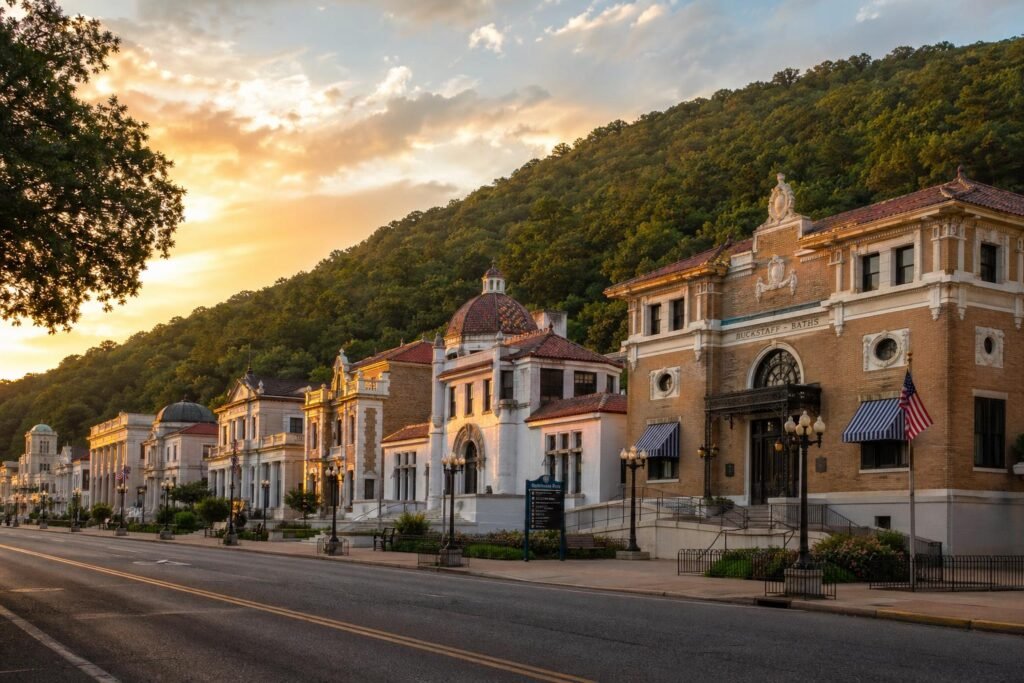
Bathhouse Row runs along Central Avenue in downtown Hot Springs, and eight of the original bathhouses still stand. Only two still operate as actual bathhouses, though. The others became museums, visitor centers, or in one case, a brewery.
Buckstaff Bathhouse is the traditionalist choice. It’s been in continuous operation since 1912—same family, same Victorian-era process. You get a thermal bath, whirlpool, hot packs, and a massage for around $90. The baths are sex-segregated, attendants wear white uniforms, and there’s a house rule against talking loudly. It feels like stepping into 1955, which is either the entire appeal or slightly claustrophobic depending on your temperament.
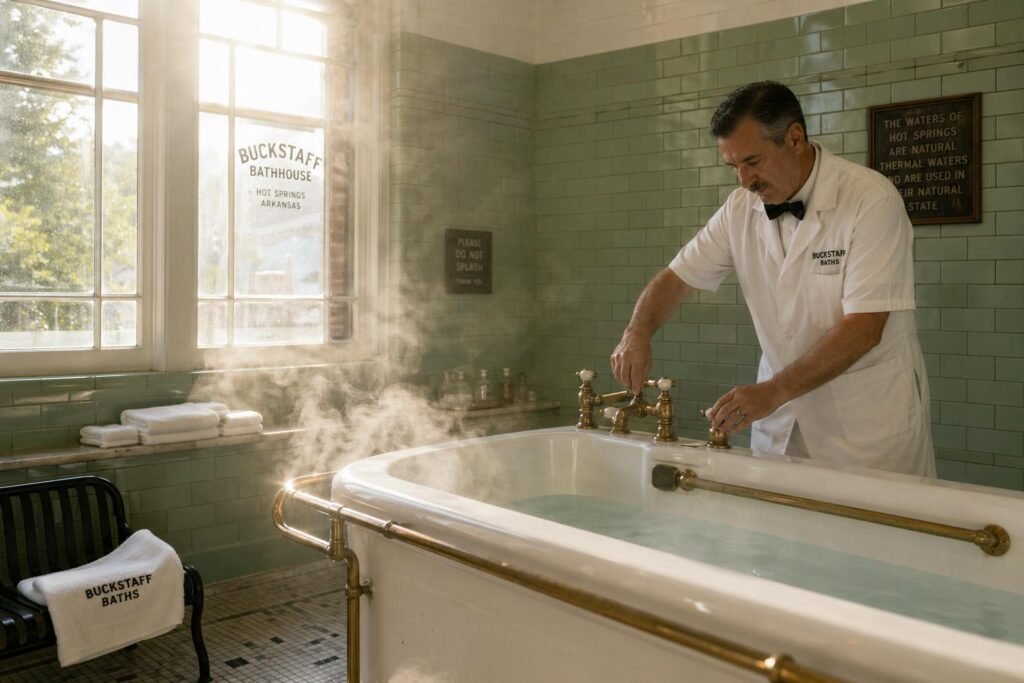
Attendant in white uniform adjusting brass fixtures on a white porcelain thermal tub, steam rising, green subway tile walls
Quapaw Baths & Spa reopened in 2008 after sitting empty for decades. They modernized without gutting the 1922 Spanish Colonial Revival building. Co-ed thermal pools, dome skylights, contemporary spa menu. The signature experience is the four-pool circuit: a large thermal pool kept at 102°F, two smaller hot pools, and a cold plunge. Day passes run $35 on weekdays. I ended up using their couples massage package last spring because the private bath suite includes a two-person soaking tub fed by the springs—something you can’t get at Buckstaff.
The thermal pools are the real draw. You’re not in some filtered, chlorinated hotel pool. This is National Park water flowing continuously through. It has a mineral taste if you accidentally get some in your mouth, and your skin feels different afterward—softer, but in a slightly slick way from the silica.
Superior Bathhouse Brewery took over the 1916 Superior Bathhouse and now brews beer using thermal spring water. Not a spa, but worth mentioning because you can drink a porter made with 4,000-year-old water for $6. The building itself is gorgeous—original tile work, brass fixtures, stained glass.
Outside Bathhouse Row proper, The Waters is a newer operation in the Arlington Hotel. Less historic character, more resort spa energy. They do treatments like thermal water hydro-massage tables and have a rooftop pool. Prices skew higher—$150+ for signature treatments.
Most people do Quapaw for the pool experience and Buckstaff if they want the time-capsule traditional bath. Both require reservations on weekends.
Modern Luxury Day Spas Beyond Bathhouse Row
Bathhouse Row gets most of the attention, but Hot Springs has quietly developed a second tier of spa experiences that feel less historic monument, more modern wellness retreat.
The Arlington Resort Hotel & Spa sits just up Central Avenue from the bathhouses. Their day spa pulls the same thermal water but runs it through a completely different aesthetic—think marble counters and eucalyptus steam instead of 1920s tile. I tried their thermal mineral bath here last spring ($55 for 20 minutes) and the setup reminded me more of a Korean spa than a national park attraction. They don’t make you feel like you’re participating in history. You’re just… soaking.
Their massage menu goes deep. Hot stone with Arkansas quartz crystals. Deep tissue that actually hurts in the good way. Couples massage rooms with side-by-side tables. Most people visiting for the day book the Thermal Water & Massage package ($165), which gets you a private mineral bath followed by 50 minutes on the table. I ended up using Viator to book mine because they had a last-minute spa package deal that included the bath, a 60-minute massage, and access to their outdoor thermal pool for about $20 less than booking direct—plus I could change my appointment time once without calling anyone. (→ OFFER: Viator)
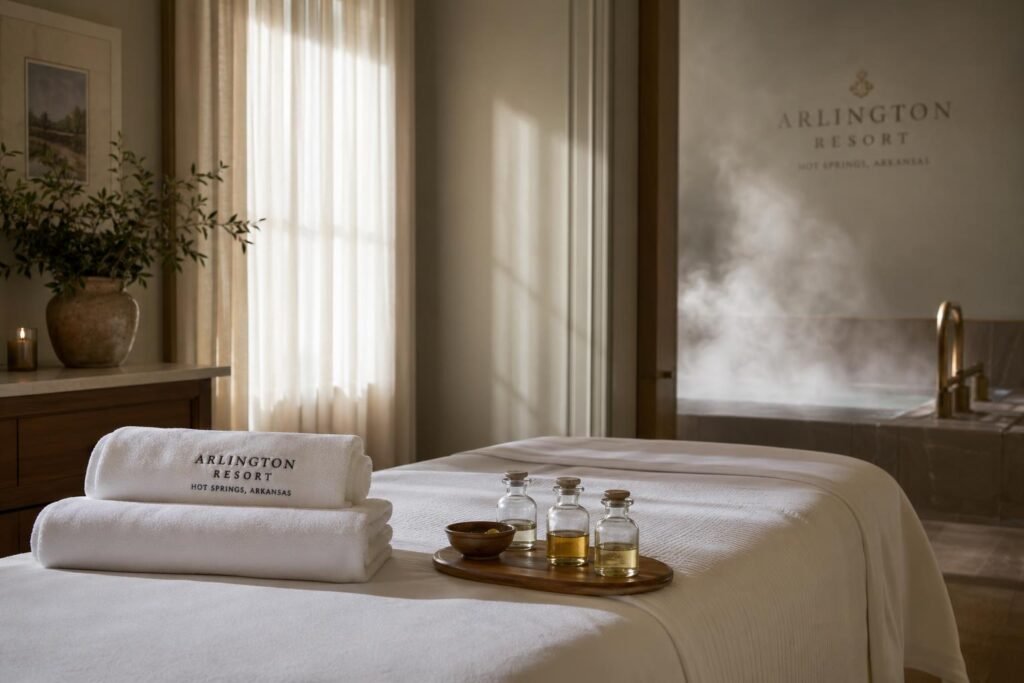
Massage table with folded white linens, small glass bottles of oil on a wooden tray, steam rising from an unseen mineral bath in the background
The Waters is newer, smaller, harder to get into. It’s tucked behind the post office on Exchange Street in a building that used to be… I actually don’t know. The owner gutted it completely. Six treatment rooms, all fed by a private thermal spring that wasn’t commercially developed until 2018.
What makes The Waters different is the temperature control. Most Hot Springs baths come out scalding—you add cold water yourself until it’s tolerable. Here, they pre-mix everything to 102°F for soaking, 98°F for their hydro-massage tubs. The Signature Thermal Soak ($75) includes 30 minutes in a deep Japanese-style tub with pulsing jets, then a rinse shower with spring water. Sounds simple. Completely wiped me out in the best way.
They also do a Detox Body Wrap using local clay from the Ouachita Mountains mixed with thermal water. You’re cocooned in warm linens for 40 minutes while the clay supposedly pulls out… something. Toxins, I guess, though I’m skeptical of those claims. What I’m not skeptical about: I slept nine hours that night.
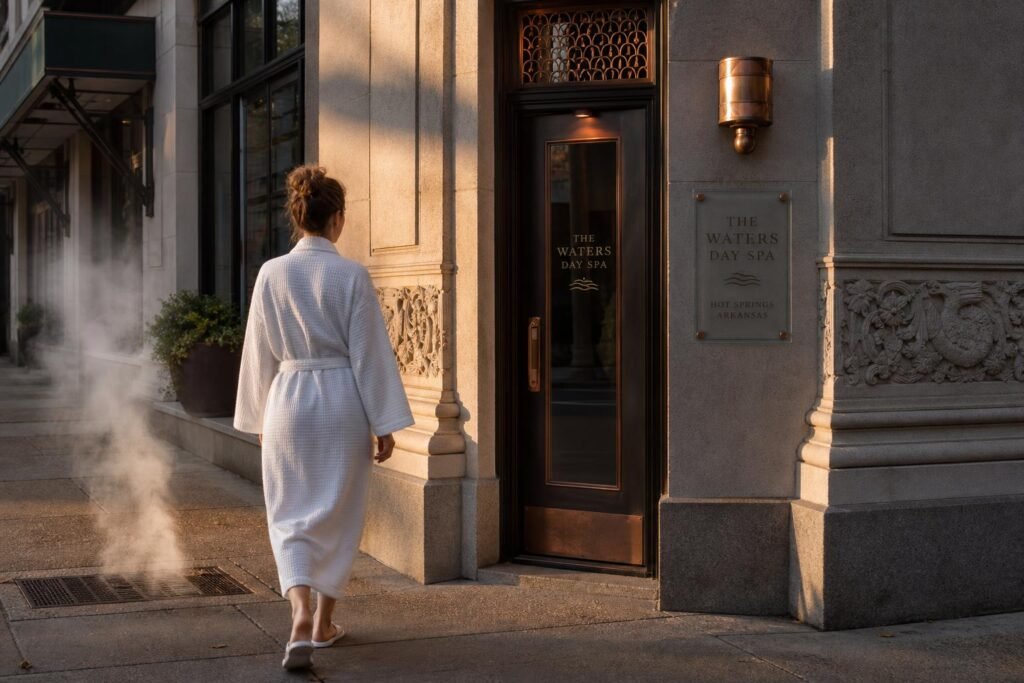
Narrow doorway with brushed copper fixtures, small etched glass sign, a woman in a white robe walking past toward the entrance, thermal steam visible from a sidewalk grate
Book ahead for The Waters. They’re appointment-only and often full by Tuesday for the coming weekend.
What Makes Hot Springs Thermal Water Special
The water coming out of the ground here hits 143°F naturally. No heating system, no geothermal plant—just rainwater that fell on Hot Springs Mountain roughly 4,000 years ago, percolated down through fractured rock, got heated by the Earth’s geothermal gradient, and is now resurfacing through 47 springs at a combined rate of 700,000 gallons per day.
That timeline isn’t speculation. Geologists traced it using radioactive isotope decay. The water is genuinely ancient.
The thermal springs emerge along a fault line in Paleozoic-era novaculite and sandstone. As the water moves through those formations, it dissolves minerals—mostly silica, calcium, magnesium, and bicarbonate. The resulting mix has a total dissolved solids content around 200-300 mg/L, which is actually pretty low compared to mineral springs in other countries. European spas often tout much higher mineral concentrations.
What Hot Springs water doesn’t have is sulfur. So it doesn’t smell like rotten eggs. First-timers always comment on this. It just smells like… hot water. Slightly metallic if you’re paying attention.
The therapeutic claims around these thermal baths go back centuries. Native American tribes were using the springs before European contact. By the 1830s, people were traveling here specifically for arthritis, rheumatism, skin conditions. The federal government protected the area in 1832—before Yellowstone, before the National Park Service even existed.
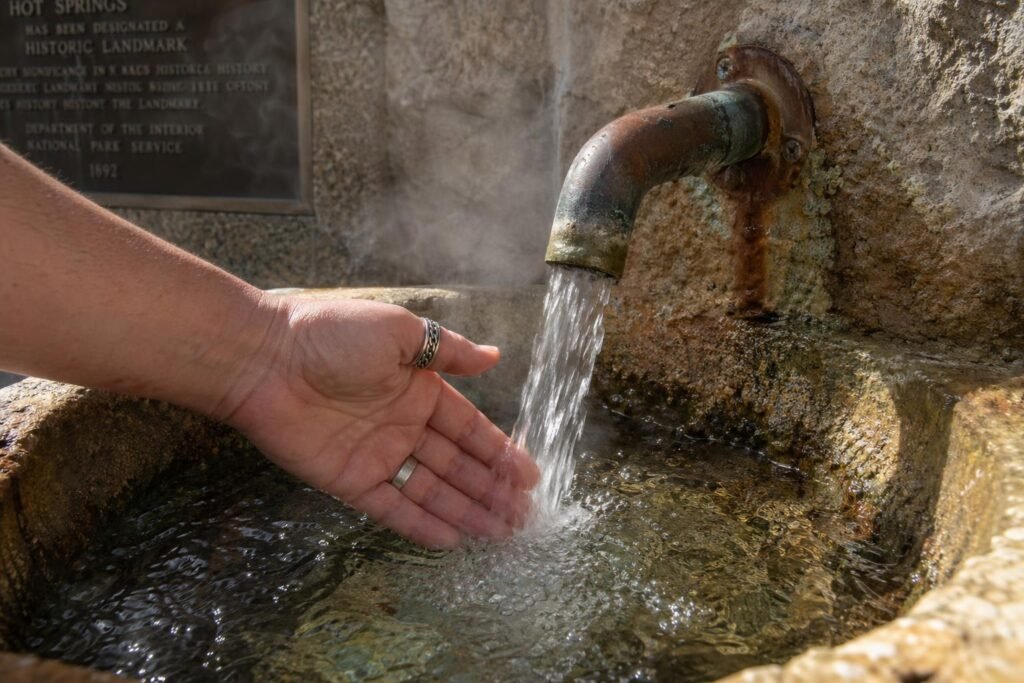
Clear water pouring from a copper spigot into a stone basin, slight steam rising, a hand testing the temperature—rings visible, no polish
Do the baths actually work medically? The research is mixed and old. Some studies from the ’90s suggested temporary pain relief for osteoarthritis. Heat therapy generally increases blood flow and relaxes muscles—that part isn’t controversial. Whether there’s something special about the mineral content specifically… less clear.
What I can tell you from talking to locals and repeat visitors: people report feeling looser, sleeping better, having less joint pain for days afterward. Placebo effect? Maybe partially. But if a 20-minute soak in 102°F water makes your knee hurt less for three days, does the mechanism really matter?
The temperature is key. Most Hot Springs baths are hotter than a standard home hot tub (usually maxed at 104°F for safety). The traditional bathing protocol here involves starting around 98°F and gradually increasing to tolerance—sometimes 106°F or higher for short periods. That heat penetration is what people chase.
One thing that is scientifically established: the water is clean. It comes out of the ground sterile, filtered by thousands of feet of rock. The National Park Service tests it constantly. You’re not soaking in recycled spa water with questionable chlorine levels. It’s fresh thermal flow, used once, then sent down the drain.
Planning Your Day Spa Experience: Packages and Pricing
Most Hot Springs day spas operate on a package model that bundles thermal baths with treatments. The basic thermal soak runs $30-45 for 20 minutes at historic bathhouses like Buckstaff and Quapaw. Add a massage and you’re looking at $125-175 for 90 minutes total.
The sweet spot is the half-day package. At Quapaw Baths & Spa, their “Revive” runs $189 for thermal pools access plus a 50-minute massage. Similar setups at The Waters and Lake Hamilton Spa hover around $200-250. Full-day experiences with facials, body wraps, and extended pool time push toward $350-400.
Most places let you build your own combination. I usually book a thermal soak first ($40), then add whatever my body needs that day—maybe a 50-minute deep tissue ($95) or a mineral body scrub ($115). Works out cheaper than pre-set packages sometimes.
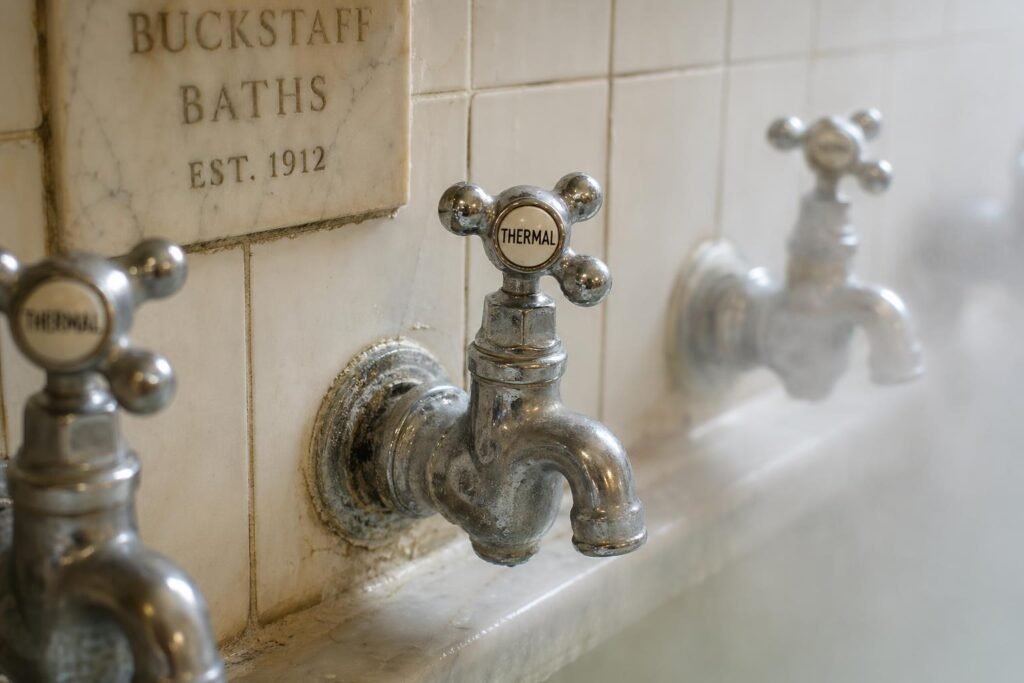
Chrome thermal water taps against white tile, slight mineral deposits visible, steam rising softly from an unseen bath just out of frame.
Couples packages offer modest savings—typically 10-15% off individual pricing. The Arlington Resort’s couples suite runs $450 for two hours including side-by-side massages and private thermal baths. Not cheap, but you’re in a 1924 building with original tilework.
Midweek specials exist if you ask. Several spas do 20% off Tuesday-Thursday before 2pm. The Waters posts rotating “locals rates” that visitors can sometimes snag if booking last-minute through their social channels.
I ended up using Viator to book a thermal bathhouse experience package because they bundled admission with a 30-minute massage at a rate I couldn’t find booking direct—saved about $25 and the confirmation was immediate, which mattered since I was driving in that morning. ↗ Viator
Tipping runs 18-20% on the service portion, not the facility fee. So if your package is $180 total but $100 of that is the massage, tip on the $100. Most spas add the suggested amount to your receipt, but it’s not automatic.
Group bookings (4+) sometimes unlock private thermal room rentals. Quapaw’s Lotus Room holds six and costs $300 for 90 minutes, basically $50 per person for a private thermal pool experience. You’d pay $45 each just for regular pool access anyway.
Best Times to Visit and Booking Tips
Spring and fall are slammed. March through May and September through November bring the festival crowds and leaf-peepers who suddenly remember Hot Springs exists. Weekend appointments vanish six weeks out during these windows.
Summer is actually easier despite being tourist season. Folks prioritize lake time over spa time when it’s 92 degrees. I’ve walked into Quapaw on a July Thursday at 11am and gotten straight into the thermal pools. Try that in October—not happening.
Weekdays own a completely different energy. Monday through Wednesday before 3pm, you might share the thermal baths with two other people instead of twenty. The historic bathhouses especially feel like private sanctuaries on Tuesday mornings. Buckstaff operates first-come-first-served on non-appointment services, and weekday waits rarely exceed 20 minutes.
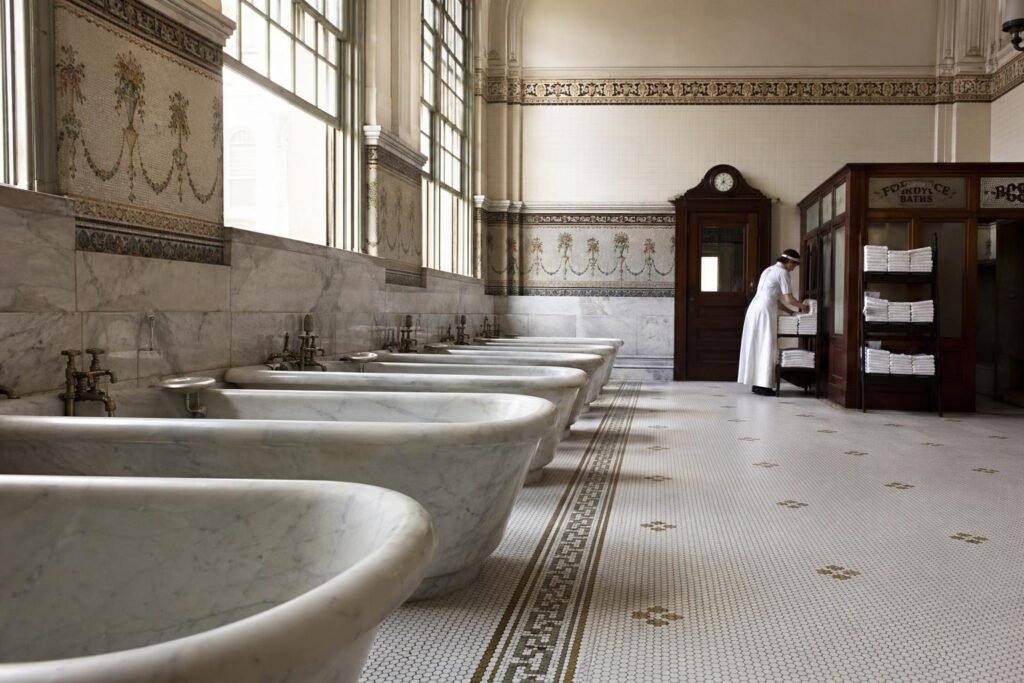
Empty white marble thermal tubs in a row, ornate tile work on walls, one attendant in period costume adjusting towels in background, completely still and quiet.
Book massage and facial appointments 3-4 weeks ahead for weekends year-round. The popular therapists get claimed fast. Thermal bath access itself—if that’s all you want—rarely requires advance booking except at Quapaw on Saturday afternoons.
January and February are dead. I mean actually quiet. Spas run deep promotions trying to fill appointment books. The thermal waters feel especially good when it’s 38 degrees outside, and you’ll have attendants who actually have time to explain the mineral content and temperature variations between pools.
Avoid the first Saturday of any month at Bathhouse Row. That’s when the free ranger-led historic tours run, and Central Avenue becomes a parking nightmare. Day spa traffic itself doesn’t spike, but getting to your appointment does.
Early morning slots (8-10am) cost the same but deliver better experiences. Facilities are freshly cleaned, thermal waters haven’t been churned by dozens of bodies, and therapists aren’t yet fatigued from back-to-back deep tissue sessions. The Arlington and The Waters both start booking at 8am—worth setting an alarm.
Most spas require 24-48 hour cancellation notice or you eat the full cost. They’re serious about this. Hot Springs operates on thin margins outside peak season, and no-shows hurt. If you’re driving from out of state, book refundable where possible.
Same-day bookings work surprisingly well Sunday through Tuesday if you’re flexible on treatment type. Call around 9am and ask what’s available. Someone always cancels, and front desks would rather fill the slot at full price than let it go empty.
Making a Complete Wellness Day: Where to Eat and Explore
Your skin’s still tingling from the thermal water, and you’ve got three hours before you need to head back. Hot Springs is small, walkable, and surprisingly good at supporting the whole wellness vibe without feeling precious about it.
Healthy Eating Downtown
Superior Bathhouse Brewery sits right on Bathhouse Row—the only brewery in a national park. They serve lunch salads that actually fill you up (the kale Caesar with blackened chicken is $14), but honestly, most people come for the beer brewed with thermal spring water. It’s touristy but legitimately interesting.
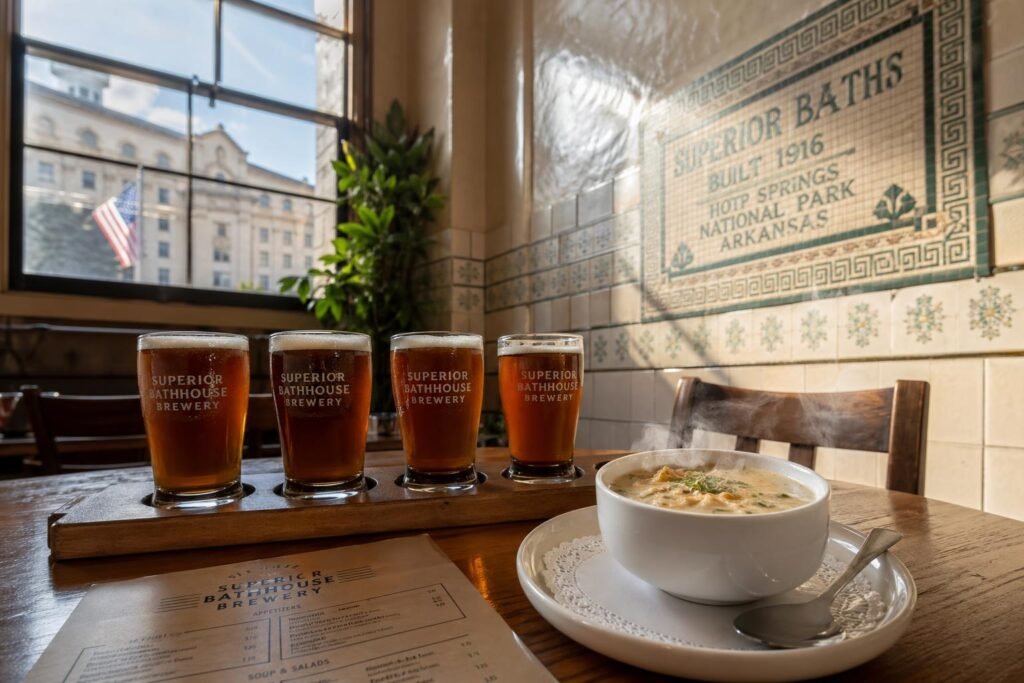
A wooden flight board with four amber beers, steam rising from a bowl of she-crab soup, Art Deco tile work visible on walls behind
For something lighter, Kollective Coffee + Tea on Central does açaí bowls ($11) and avocado toast that’s better than it has any right to be in a town of 38,000 people. The cold brew’s strong. They close at 5 p.m., so plan accordingly.
The Root Coffeehouse is where locals actually go—mason jar salads, bone broth by the cup, kombucha on tap. It’s in a converted house two blocks off Central Avenue. Everything’s under $12, and the vibe is more yoga mat than spa robe.
Complementary Activities
The Grand Promenade is a half-mile brick walkway behind Bathhouse Row. Takes maybe 20 minutes to walk end to end, with mountain views and zero crowds even on weekends. Good for stretching out those loosened muscles before you get back in the car.
Hot Springs Mountain Tower costs $9 to go up, but the view’s legitimately worth it if the weather’s clear—you can see three mountain ranges. Takes about 15 minutes total. I skip it when it’s hazy.
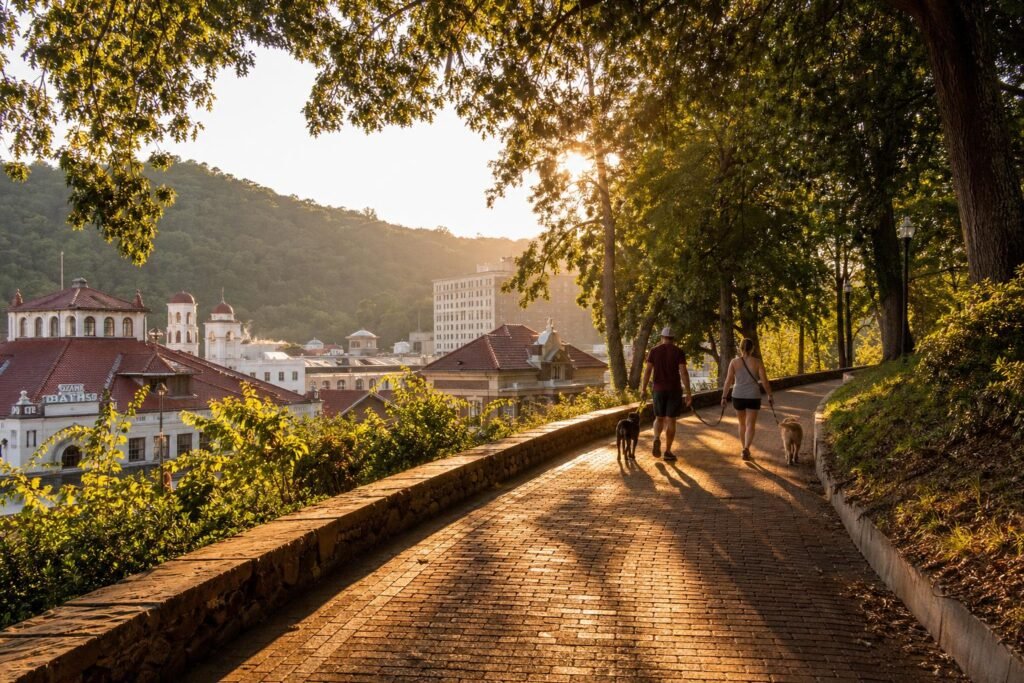
Red brick walkway curves through oak trees with dappled shadow, historic bathhouse rooflines visible below, two people walking dogs in middle distance
Gangster Museum of America is weirdly perfect after a spa day—just enough stimulation without being exhausting. It’s small (30 minutes max), air-conditioned, and Al Capone actually spent time in Hot Springs. $14 admission.
If you booked a late afternoon spa slot, the Arlington Resort’s observation deck has sunset views over the valley. It’s technically for hotel guests, but no one checks if you walk in confidently and take the elevator up.
The Timing Dance
Most people do spa first, then eat and explore. But I’ve had better experiences doing it backward—light lunch, walk the Promenade, then spa at 3 or 4 p.m. when day-trippers have left. You’re already relaxed when you hit the thermal water, and you drive home in that floaty post-massage state instead of getting hungry an hour later on the highway.
The town essentially shuts down by 8 p.m. except for a few restaurants. If you’re making a full day of it, plan your spa appointment to end by 5 or 6 at the latest so you’re not scrambling for dinner options.
Day Spa Etiquette and What to Bring
First-timers always overpack for spa days. Then they spend half their visit wondering why they brought three outfit changes for a bathrobe experience.
What’s Actually Provided
Every legitimate day spa in Hot Springs provides robes, slippers, and towels. You’ll get a locker with a key you wear on your wrist. Some places (Buckstaff, Quapaw) provide disposable underwear for thermal baths—yes, it’s as weird as it sounds, but you get used to it in about 30 seconds.
Shampoo, conditioner, body wash are standard in shower areas. Hair dryers, usually. Cotton swabs and lotion in the nicer places. The Historic Leyendecker Hotel’s spa has Aveda products. Palace and Buckstaff have whatever works—nothing fancy, but it does the job.
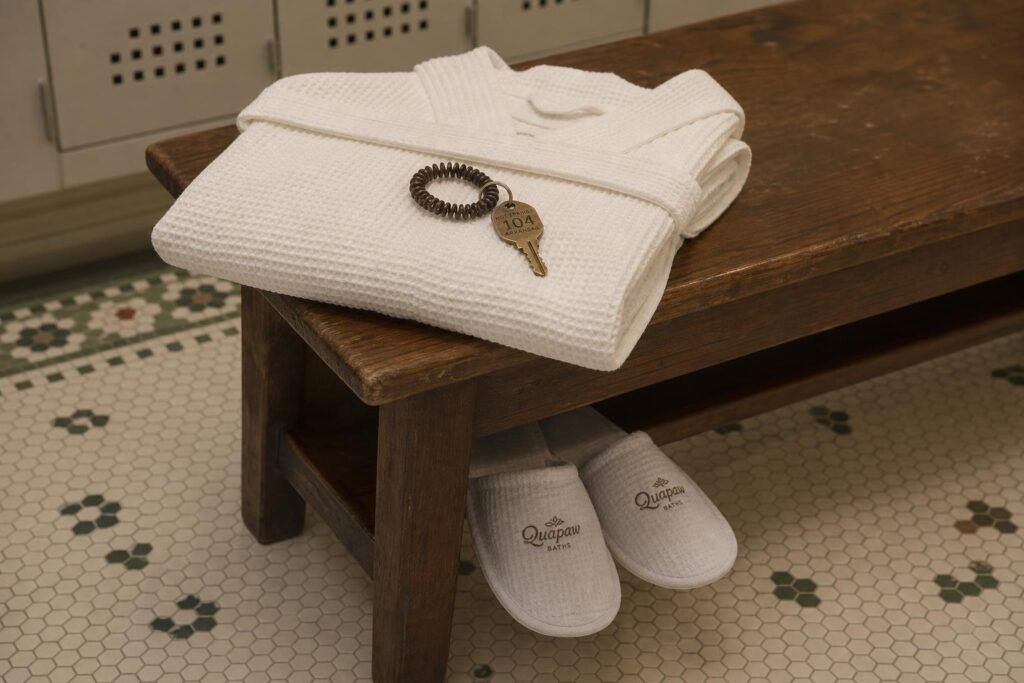
Folded white waffle-weave robe on wooden bench, key on elastic wristband, pair of spa slippers tucked underneath, vintage tile floor
What they don’t always have: hair ties, deodorant, razors, contact lens solution. Bring those.
The Packing List
Swimsuit—obviously, though some thermal baths have private tubs. A book or podcast if there’s waiting between services, but honestly, most people just zone out. Flip-flops if you’re particular about locker room floors, though provided slippers are fine.
Water bottle. You’ll sweat more than you realize in thermal baths, and not every spa has fountains everywhere. I bring a 20-ounce stainless steel one and refill it twice.
If you’re doing outdoor thermal pools (Quapaw has them), sunscreen for between dips. The Arkansas sun is stronger than it looks.
Money Matters
Tipping here works like anywhere else—15-20% for good service, added to your card at checkout. Most people do 20% because spa therapists in Hot Springs aren’t making California wages. If someone spent 90 minutes unknotting your shoulders, an extra $5 isn’t going to hurt you.
Some places (Buckstaff particularly) have attendants who help you navigate the thermal bath circuit—hot room, vapor cabinet, sitz bath, needle shower. They’re not licensed massage therapists, but they’re running around keeping everything flowing. $5-10 cash per person is standard. Bring small bills.
Thermal Bath First-Timer Notes
The water’s going to be hotter than your home bath—around 102-104°F coming out of the ground. Start with 15 minutes max in the thermal tub, especially if you have any blood pressure issues. You can always go back in.
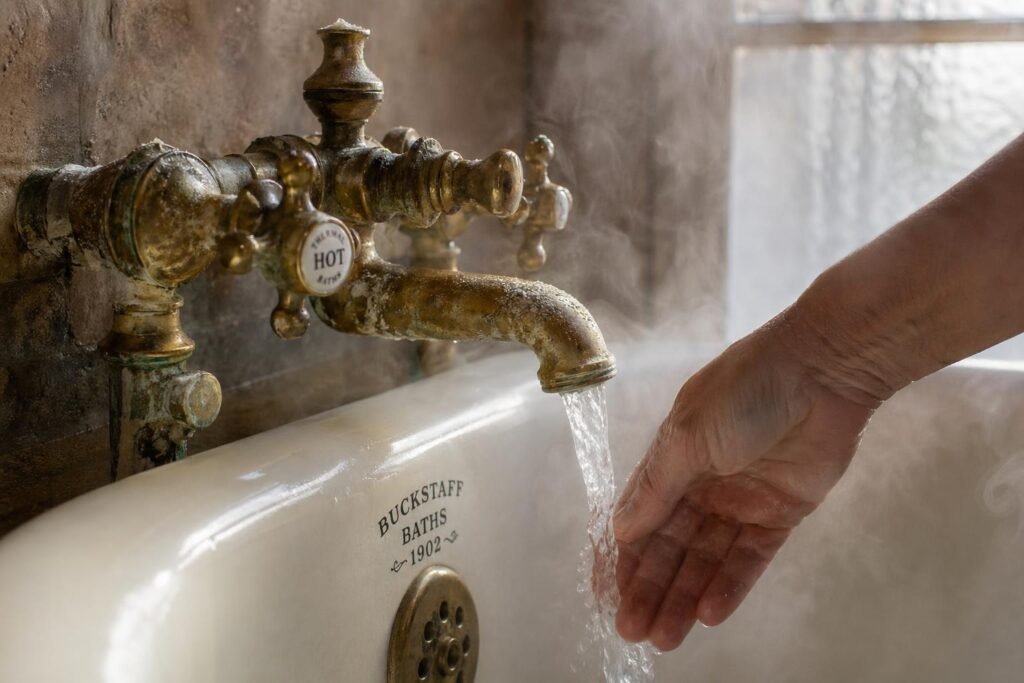
Brass fixtures with mineral deposits, hot water pouring into white porcelain tub, steam rising through frame, someone’s hand testing temperature
The “needle shower” is a weird multi-head shower situation from the 1920s that shoots water at you from six directions. It’s startling the first time. Just go with it.
You’re supposed to shower before entering communal thermal pools. Not a suggestion—the mineral content is high enough that body oils mess with the water chemistry. Takes 60 seconds, saves everyone’s experience.
Timing and Tech
Leave at least 15 minutes between your arrival time and your first service. These aren’t airport spas—there’s a whole ritual of changing, storing stuff, figuring out where everything is. Rushing directly from your car to a massage table makes for a tense first 20 minutes.
Most spas ask you to turn phones off entirely, not just silence them. Fair enough—no one wants to hear someone’s notification dings echoing off 1920s tile work. I put mine in the locker and genuinely forget about it for two hours. Radical concept, I know.
If you’re doing multiple services, eat something light beforehand. The combination of heat and massage on an empty stomach makes some people woozy. A banana and some crackers an hour before does the job.