

Adventurous travelers seeking unique outdoor experiences that combine paddling with natural thermal waters.
Why Kayaking Hot Springs is the Ultimate Adventure
I’ll be honest—the first time someone told me about paddling through hot springs, I thought they were confused. Hot tubs are for sitting. Kayaks are for rivers. But then I spent a February morning on Boiling River near Yellowstone, steam rising off the water while my fingers went numb on the paddle, and I got it.
The thing about thermal kayaking is you’re moving through these pockets of temperature. One stroke and you’re in 55-degree river water. Three strokes later, you hit a thermal vent and it’s suddenly bath-warm around your legs. Your body doesn’t know what to do with the information.
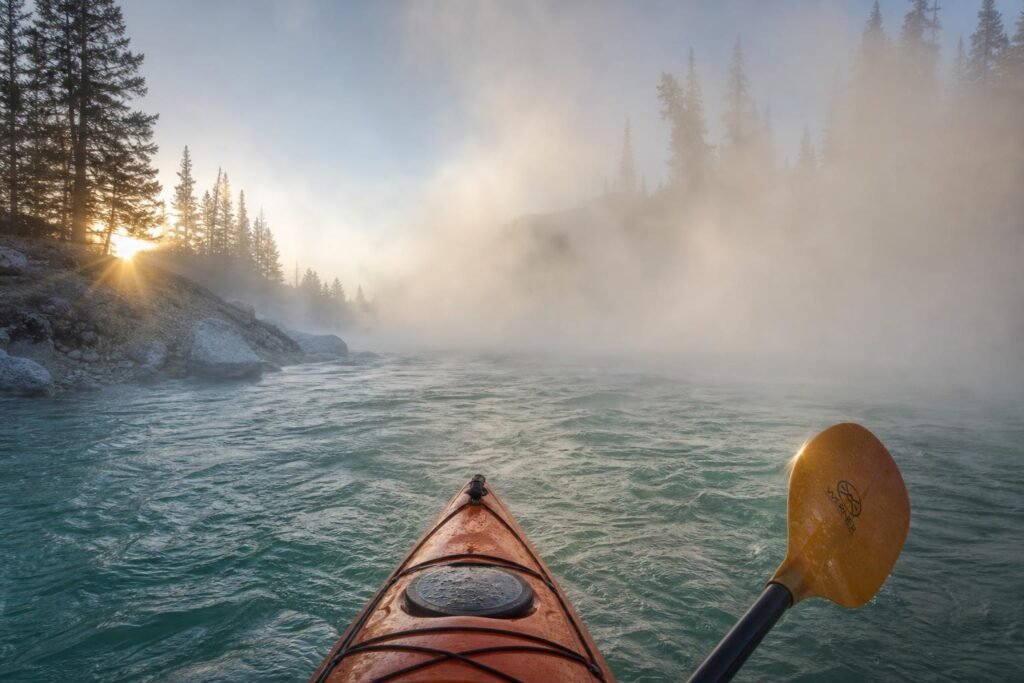
Most hot springs you just sit in. You get prune fingers and someone’s uncle talks too loud about real estate. But paddling through thermal zones? You’re covering miles. Seeing wildlife that comes down for the warm water—I’ve had elk watch me from the bank at dawn, their breath mixing with the steam. The mineral smell is sharper when you’re moving through it.
The therapeutic part is real but not what you’d expect. It’s not a sustained soak. It’s these moments where warmth floods your lower back or your shoulders as you paddle through a hot seam. Then it’s gone. Your muscles don’t relax exactly—they wake up in a different way.
And the scenery is strange. Thermal areas look alien. You get these colors—rust orange from iron, milky turquoise from silica, that sulfur yellow. Most kayaking is beautiful in a normal way. This feels like paddling through another planet’s river system.
The catch is timing and access. Most places restrict when and where you can paddle near thermal features. Yellowstone’s strict about it. Some hot springs are too fragile or too hot. But the spots where it works? Worth the research.
Top Hot Springs Destinations for Kayak Rentals in North America
Yellowstone National Park is the obvious one, but you can’t just paddle anywhere. The Firehole River is your best bet—it runs through thermal basins and reaches 80 degrees in summer sections. Launch at Firehole Canyon Drive. You’ll pass Excelsior Geyser runoff and the Grand Prismatic outflow. The park makes you stay in designated areas, and honestly, the rules are there because people have died ignoring them.
Best time is September. Fewer tourists, water’s still warm enough, air is cold enough that the steam shows up in photos. It’s a day-use permit situation, free but required. Don’t skip it.
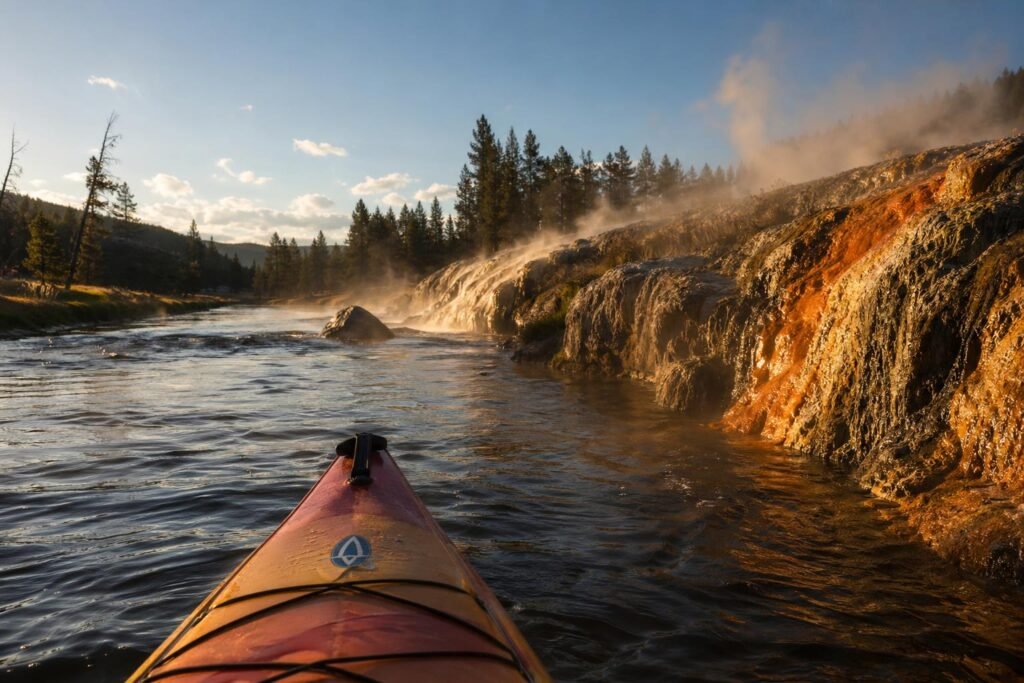
Kayak bow in foreground with orange mineral deposits visible on rocks along shoreline, steam wisps catching warm light
Idaho has Kirkham Hot Springs along the South Fork Payette River. This one’s different—you’re kayaking a cold river that happens to have hot springs on the bank. You can pull over mid-paddle and soak. The hot springs themselves are too small to kayak through, but the combination works. Paddle a few miles of Class II-III rapids, stop and soak, keep going.
It’s free, no permits. The road is rough getting in—I scraped my rental car’s undercarriage—but manageable in summer. Kirkham gets crowded on weekends. Go Tuesday morning in June.
There’s also Lava Hot Springs in southeastern Idaho, but don’t bother with a kayak. The commercial pools are great for soaking, terrible for paddling. Save your energy.
California has two worth knowing about. Hot Creek near Mammoth Lakes used to allow swimming and paddling until someone died in 2006. Now it’s closed to entry, but you can kayak Crowley Lake nearby and drive over to see Hot Creek’s thermal features. Not the same, but the Eastern Sierras in that area are ridiculous in fall.
The better California option is paddling to Sykes Hot Springs in Big Sur. You hike in 10 miles along the Big Sur River—no kayaking on the hike—but some people pack inflatable kayaks to use in the river pools near the springs. I met a guy doing this with a Kokopelli Rogue. He said it was barely worth the pack weight, but he’s also the kind of person who brings a hammock stand backpacking.
Actual thermal kayaking happens at the mouth of Hot Springs Creek where it meets the Big Sur River. Water’s maybe 75 degrees, which doesn’t sound hot until you’ve been in a 62-degree river all day. Permits required—Big Sur gets 40 people per day max for overnight. Book three months out.
British Columbia has more options than anywhere else. Halfway Hot Springs on Halkett Bay in Princess Louisa Inlet is accessible only by boat. You kayak through the inlet—it takes 6-8 hours from the nearest boat launch—and there are natural hot springs at the base of a waterfall.
I haven’t done this one yet. It’s on my list for next August. Everyone says the paddle is stunning but exhausting. The inlet has dramatic granite walls. You need to time it with tides and weather. Most people do it as a multi-day kayak camping trip.
Essential Gear for Hot Springs Kayaking
Your standard kayaking setup won’t cut it here. I learned this the hard way at Spencer Hot Springs in Nevada when my regular PFD straps started feeling like a wool sweater in 104°F water.
Start with a thin, quick-dry PFD—not those bulky foam bricks. Astral makes one called the YTV that I’ve used in thermal waters from Idaho to Iceland. It’s mesh-backed and doesn’t trap heat against your core like traditional vests.
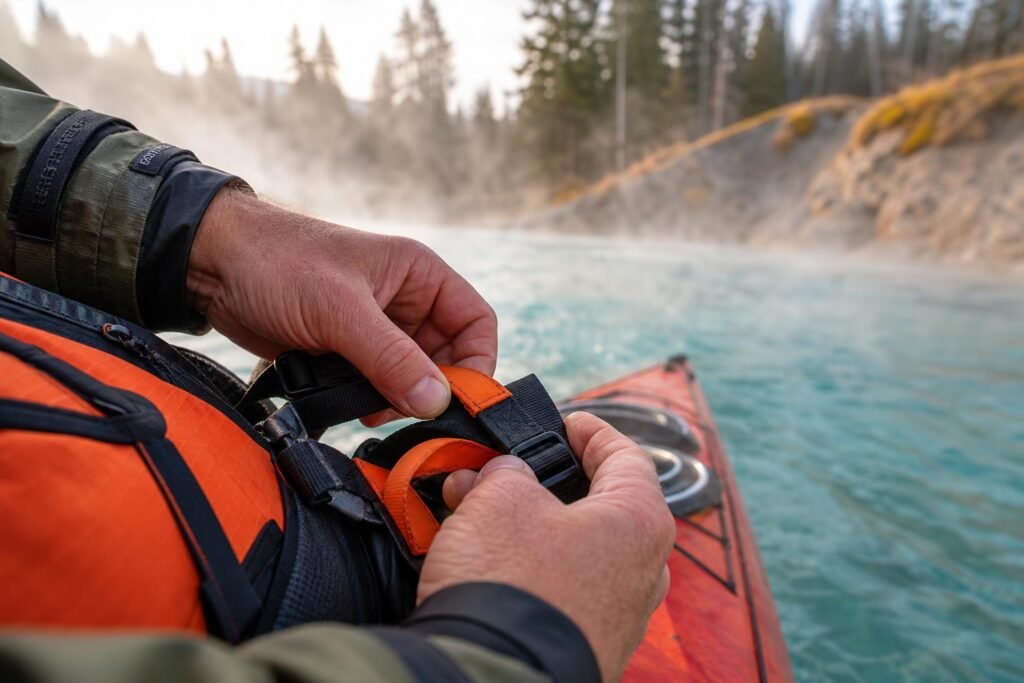
Hands adjusting bright orange PFD straps on kayak deck with thermal steam rising from turquoise water in soft focus behind
Footwear matters more than you’d think. The rocks around hot springs accumulate algae and minerals that get slicker than ice. I use Astral Brewers—they’re neoprene water shoes that grip in temperatures up to 120°F. Flip-flops will absolutely wreck you. Saw a guy slice his foot open on volcanic rock at Landmannalaugar because he wore Tevas.
For the kayak itself, sit-on-tops work better than sit-insides. You’re going to get wet, and you want to cool off easily. Most rental places near hot springs stock them for this reason.
Bring a dry bag even if it’s just a day paddle. Your phone, car keys, and that protein bar will thank you when steam and splashing inevitably happen. The 10L Sea to Summit bags run about $35 and compress down to nothing. ↗ Sea to Summit dry bags
Sun protection is weirdly crucial. The water reflects UV like crazy, and you’re moving slowly enough that you’re basically baking. I pack reef-safe sunscreen (required at many thermal areas), a wide-brim hat that clips on, and lightweight long sleeves. The OR Echo hoodie breathes well enough that you won’t overheat even in warm water.
Water. Yes, you’re surrounded by it, but you can’t drink it. Thermal water often contains sulfur, arsenic, or enough minerals to give you impressive GI issues. I carry 3 liters minimum and refill from safe sources.
A small first aid kit with tweezers and antibiotic ointment. Hot springs areas mean sharp volcanic rock, and cuts get infected fast in warm water. Add moleskin if you’re hiking to put-in points.
How to Find and Book Kayak Rentals Near Hot Springs
Most hot springs don’t have rental kiosks in the parking lot. You’re going to do some detective work.
Start local. Google “[hot spring name] kayak rental” and ignore the first three results—they’re usually generic outdoor retailers 50 miles away. Call the nearest outdoor shop directly. In Pagosa Springs, Colorado, the Ski & Bow Rack rents inflatables for $40/day specifically for the hot springs stretch of the San Juan River. They know the put-in spots and current conditions because they’re locals.
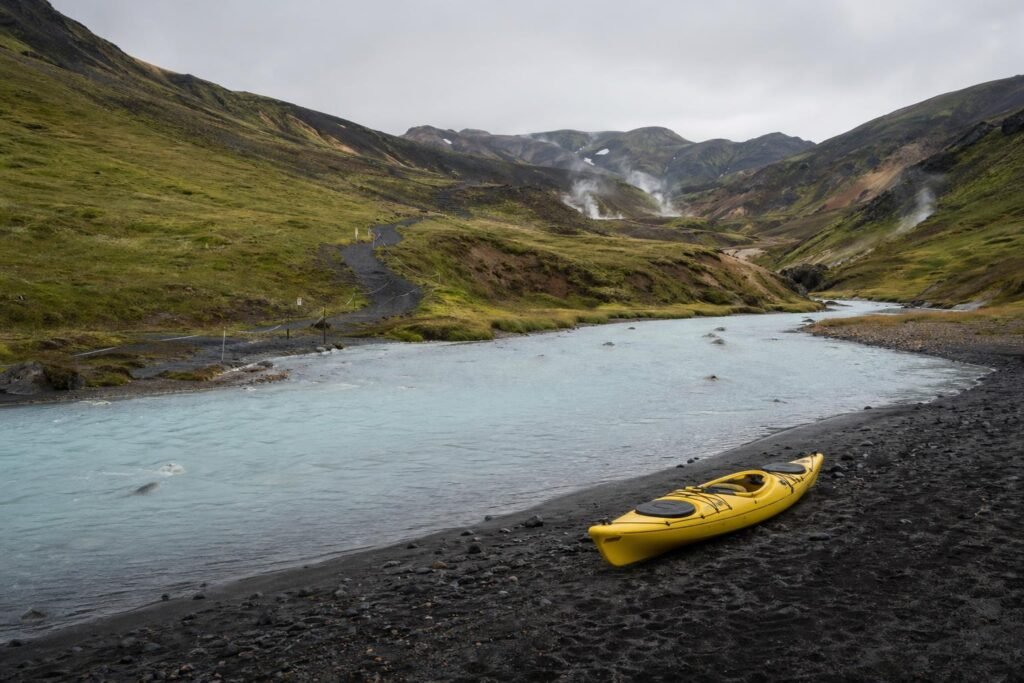
Single yellow kayak resting on black volcanic sand beside milky blue thermal stream with hiking trail visible on far bank and mountains in distance
Check with the hot spring resort or park office first. Many have partnerships with outfitters or their own rental programs. Chena Hot Springs in Alaska arranges kayak access through their activity desk—you won’t find that listed online anywhere useful. Call them at (907) 451-8104 and ask directly.
For remote hot springs, look at the nearest town with a population over 2,000. That’s usually where the outdoor rental economy lives. Before paddling to Kirkjufell hot pots in Iceland, I found rentals in Grundarfjörður, not at the springs themselves.
Pricing varies wildly. Expect $35-60/day for a single kayak, $70-100 for a tandem. Inflatable kayaks run cheaper but handle worse in current. In New Zealand, I paid $45 NZD for a hard-shell from Hot Water Beach Surf Shop versus $30 for an inflatable from a gas station—the extra $15 was worth it when wind picked up.
Book 2-3 days ahead in summer, a week ahead near holiday weekends. Memorial Day through Labor Day, every rental place near Oregon’s Bagby Hot Springs runs out by 10 AM. I use GetYourGuide for booking outdoor activities now because they show real-time availability and let you filter by pickup location. ↗ GetYourGuide
Ask about shuttle services. Some outfitters will drop you upstream and pick you up downstream. Raft & Kayak in Salida, Colorado does this for $15 per person on the Arkansas River near Cottonwood Hot Springs. Way better than hitchhiking back to your car.
Seasonal availability is real. High-altitude hot springs close rental operations October through May. The Boiling River in Yellowstone shuts down entirely during spring runoff—too dangerous. Always call ahead even if the website says they’re open.
One last thing: ask about water levels when you book. Hot springs fed by rivers can become sketchy or impossible depending on snowmelt and rain. The outfitter will know if you’re better off postponing or switching locations.
Safety Considerations and Water Temperature Guidelines
I learned about thermal water safety the hard way in Iceland when I paddled too close to a geothermal vent and nearly cooked myself. The water went from pleasant to painfully hot in about three paddle strokes.
Here’s what actually matters: water above 104°F (40°C) isn’t safe for prolonged paddling. Your core temperature rises fast, and you don’t notice until you’re dizzy. Most kayakable hot springs sit between 85-100°F, which sounds perfect until you’re exerting energy. What feels amazing when you’re floating becomes exhausting when you’re actively paddling.
Watch for these signs in yourself and your group: excessive sweating that suddenly stops, confusion, nausea, or that weird feeling where you can’t quite focus your eyes. I’ve seen people insist they’re fine while literally swaying in their kayak. If someone seems “off,” get them to cooler water immediately.
The tricky part is that thermal areas rarely have uniform temperatures. In New Zealand’s Lake Rotoiti, I paddled through pockets that ranged from tepid to scalding within ten feet. Always test unknown water with your hand first—never just paddle into steam.
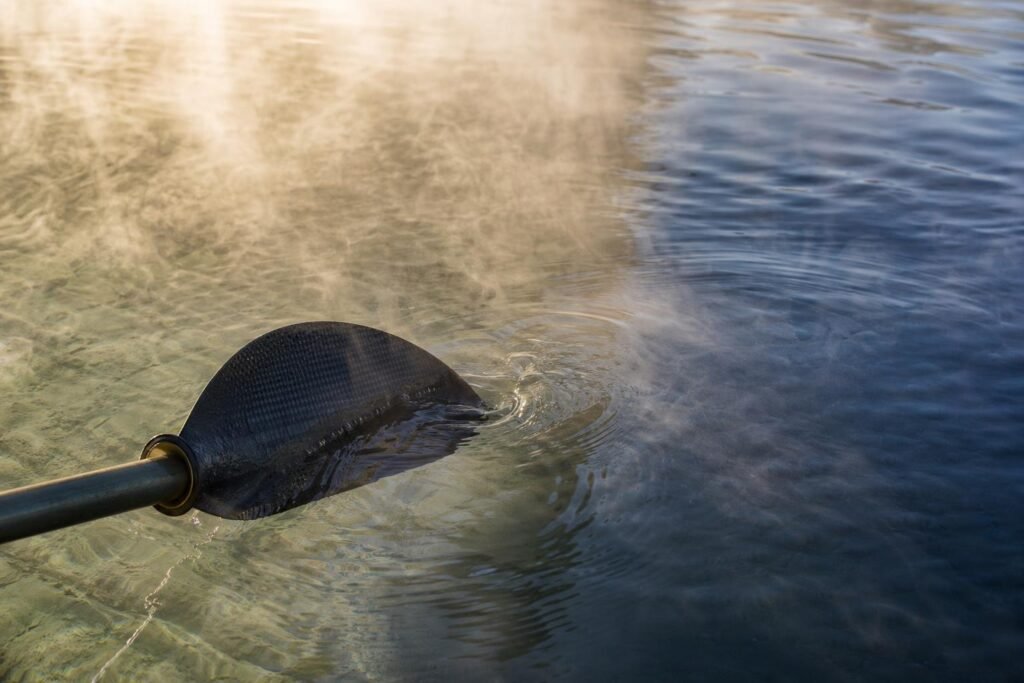
Kayak paddle blade creating ripples where cool lake water meets a rising column of steam from thermal vents below, the surface showing visible temperature gradient
Cold water is actually your friend in these environments. I keep a water bottle to pour on my neck and wrists every 20 minutes. Sounds excessive, but heat exhaustion sneaks up fast when you’re surrounded by warm water and can’t cool down through normal evaporation.
Avoid hot springs kayaking if you’re pregnant, have heart conditions, or take medications that affect temperature regulation. Also skip it if you’ve been drinking—alcohol and thermal water are a legitimately dangerous combination. I watched a drunk guy in Oregon nearly drown in four feet of warm water because he couldn’t coordinate his movements.
The 20-minute rule works for most people: paddle actively for 20 minutes, then take a break in cooler water or on shore. Your body needs to dump heat. If there’s no cool water nearby, that location isn’t suitable for kayaking, only for stationary soaking.
Best Times of Year for Hot Springs Kayaking
Winter is counterintuitively the best season for hot springs kayaking. I’ve paddled in Montana’s Bozeman Hot Springs when it was 15°F outside, and the contrast made the whole experience surreal—clouds of steam so thick I navigated by feel, my face cold while my legs stayed warm.
The water temperature in natural hot springs stays relatively constant year-round, but winter air creates that dramatic temperature differential. Plus, summer’s crowds disappear. I had Oregon’s Bagby Hot Springs area almost entirely to myself in February, versus July when there’s a literal queue for kayak launches.
Spring (March-May) brings two advantages: snowmelt creates higher water levels in rivers connected to hot springs, and wildlife emerges. I’ve seen more moose, deer, and birds during spring paddles in Wyoming than any other season. But research your specific location—some hot springs get dangerously high flows during peak melt.
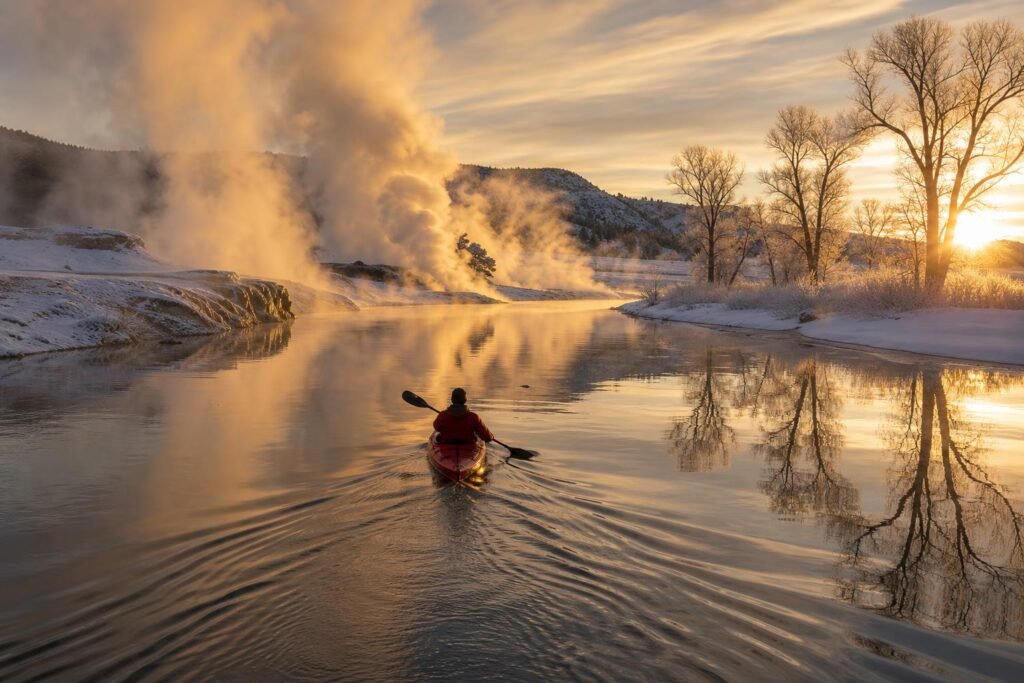
Solo red kayak cutting through mirror-still water creating perfect V-wake, massive plumes of steam rising from thermal features on riverbank, bare cottonwood trees rimmed with frost
Summer (June-August) works if you go early morning or evening. Midday paddling in 95°F air plus 98°F water is miserable. I’ve done it in California’s Hot Creek—you overheat fast and there’s nowhere to cool down. Summer also means algae blooms in some thermal areas, which isn’t dangerous but makes everything smell like sulfur and rotten eggs.
Fall (September-November) is my second choice after winter. Water’s still warm, air’s cool enough to prevent overheating, and you get changing foliage in places like Colorado and Montana. The thermal features actually become more visible as ambient temperatures drop and steam increases.
Crowd levels matter more than most people think. I’ve paddled New Zealand’s hot springs in their winter (June-August) and had entire bays to myself. Same locations in January? Packed with tourists doing exactly what I was doing.
Weather wildcards: wind is your enemy in thermal areas because the water’s often calm and protected, meaning you’re not used to paddling in chop. Sudden wind creates waves that splash hot water into your kayak. I’ve also been caught in rain while paddling hot springs in Iceland—cold rain hitting hot water creates this disorienting temperature chaos where you can’t tell if you’re too hot or too cold.
Check local regulations before planning. Some hot springs close to kayaking during wildlife breeding seasons or when water levels drop too low. Arkansas’ Hot Springs National Park, for instance, restricts access during certain months.
Planning Your Hot Springs Kayaking Trip
Start with your base camp. Hot springs kayaking spots are rarely in town, so you’re looking at lodges, campgrounds, or vacation rentals within striking distance of the water. I stayed at a basic motel in Truth or Consequences, New Mexico—$65/night, walking distance to the put-in for Elephant Butte. Nothing fancy, but it had a kitchenette where I could prep breakfast before dawn paddles.
In Iceland, most people cluster around Reykjavik and drive out. That’s fine for day trips to places like the Reykjadalur area. But if you’re serious about chasing multiple hot springs, rent something closer to Mývatn or Landmannalaugar. You’ll shave hours off your driving.
Multi-day itineraries work best when you’re not rushing. I mapped a five-day loop through central Idaho once—put in at different hot springs along the Salmon River drainage, camping between. Two paddles per day, max. The rest was soaking, cooking over a fire, not doing much. That rhythm matters more than checking boxes.
Pair hot springs with other stuff if you’re traveling with non-kayakers. Yellowstone is obvious—half your group hikes to the Grand Prismatic while you paddle Lewis Lake. Oregon’s Umpqua Hot Springs sits twenty minutes from world-class mountain biking. My partner spent mornings on trails while I was on the water. We met up for the soak.
Most of my route planning now runs through Gaia GPS, which layers topo maps with satellite imagery so you can spot thermal runoff before you launch. The premium version costs $40/year, and I’ve used it on probably fifteen trips at this point—easier than stitching together free maps and guessing where access points are.
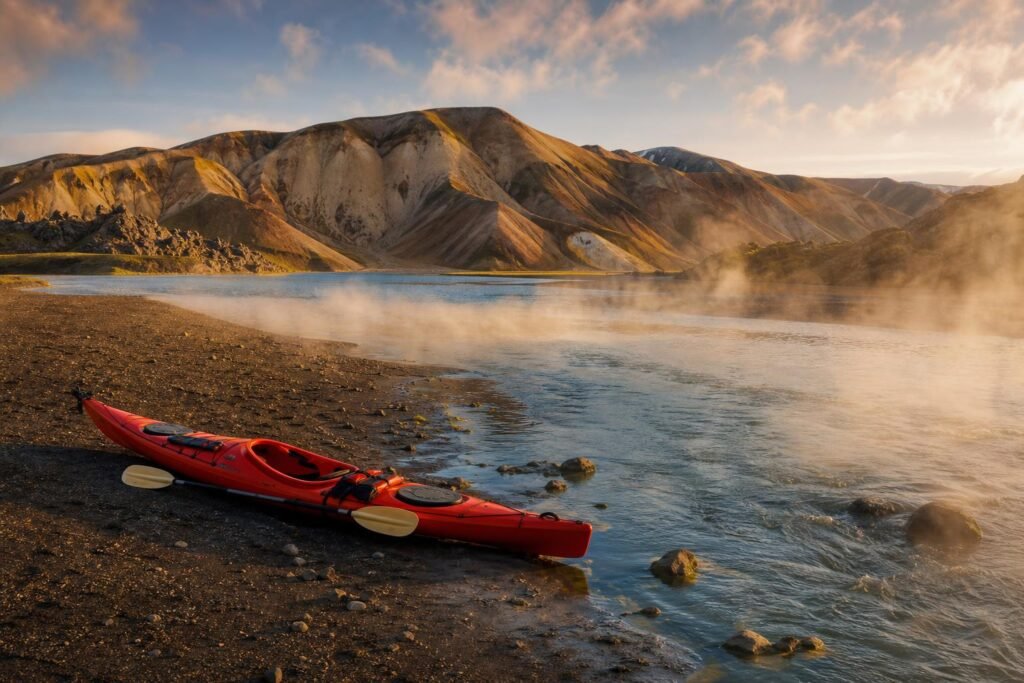
Kayak beached on black sand shoreline, steam rising from turquoise stream meeting lake, rhyolite mountains in soft focus background
Book lodging early if you’re going peak season. June through August in places like Stanley, Idaho, or Pagosa Springs, Colorado—everything fills up. I’ve slept in my car more than once because I assumed I’d find something last-minute. You won’t.
Environmental Etiquette and Conservation
Geothermal ecosystems are fragile in ways that aren’t obvious until you’ve already screwed up. That bright orange mat around a hot spring? Thermophiles—bacteria that exist nowhere else on Earth. Your paddle dragging through it, your foot stepping off the boardwalk, can wipe out colonies that took decades to form.
Stay on designated paths and put-ins. Yellowstone’s thermal areas have them for a reason. I’ve watched people bushwhack down to a spring’s edge for a photo, killing microbial mats with every step. If there’s no clear trail, you probably shouldn’t be there.
Leave No Trace isn’t optional around hot springs. Pack out everything, including the orange peel you think will biodegrade. In cold, high-altitude environments, organic matter barely breaks down. And don’t add soap—even biodegradable stuff—to thermal water. It doesn’t disappear. It accumulates.
Some hot springs sit on private land or require permits. Do the research. Mystic Hot Springs in Utah lets you soak but not paddle without permission. Parts of the Alvord Desert in Oregon are open; others aren’t. I once drove four hours to a hot spring only to find a locked gate and a “No Trespassing” sign I’d missed online.
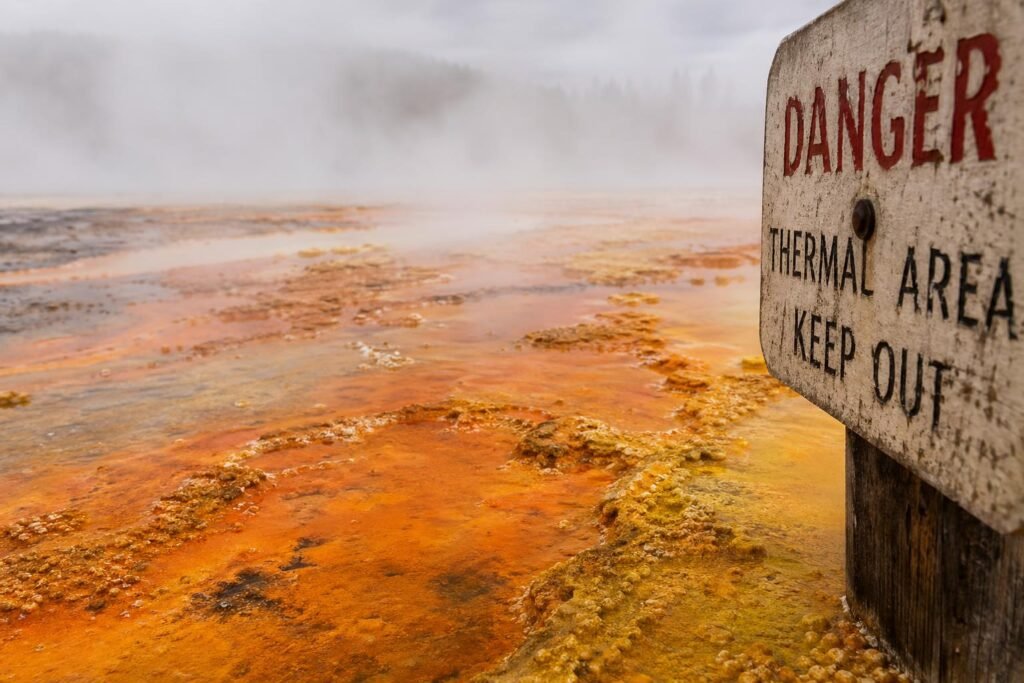
Vibrant orange and yellow bacterial mat at spring edge, steam obscuring background, weathered warning sign partially visible
Water temperature matters for the ecosystem, not just you. Dumping cold river water into a hot spring pocket—or vice versa—messes with the species adapted to that exact temperature range. Keep your paddle strokes smooth and contained when you’re near thermal vents.
Wildlife uses hot springs too, especially in winter. Elk, bison, birds—they’re drawn to the warmth. Give them space. If an animal changes its behavior because you’re there, you’re too close. I’ve had to wait thirty minutes for a moose to finish drinking before I could launch. That’s just how it goes.
Regulations shift constantly, especially in national parks and wilderness areas. Check with the local ranger station or land management office a week before your trip. What was legal last year might not be now. Some areas have closed entire hot springs to public access after overuse damaged them beyond repair.